
Poland's UEFA Coefficient Rise: What's Behind the Climb Toward the Top 10?
· Author: Karel Zbíral
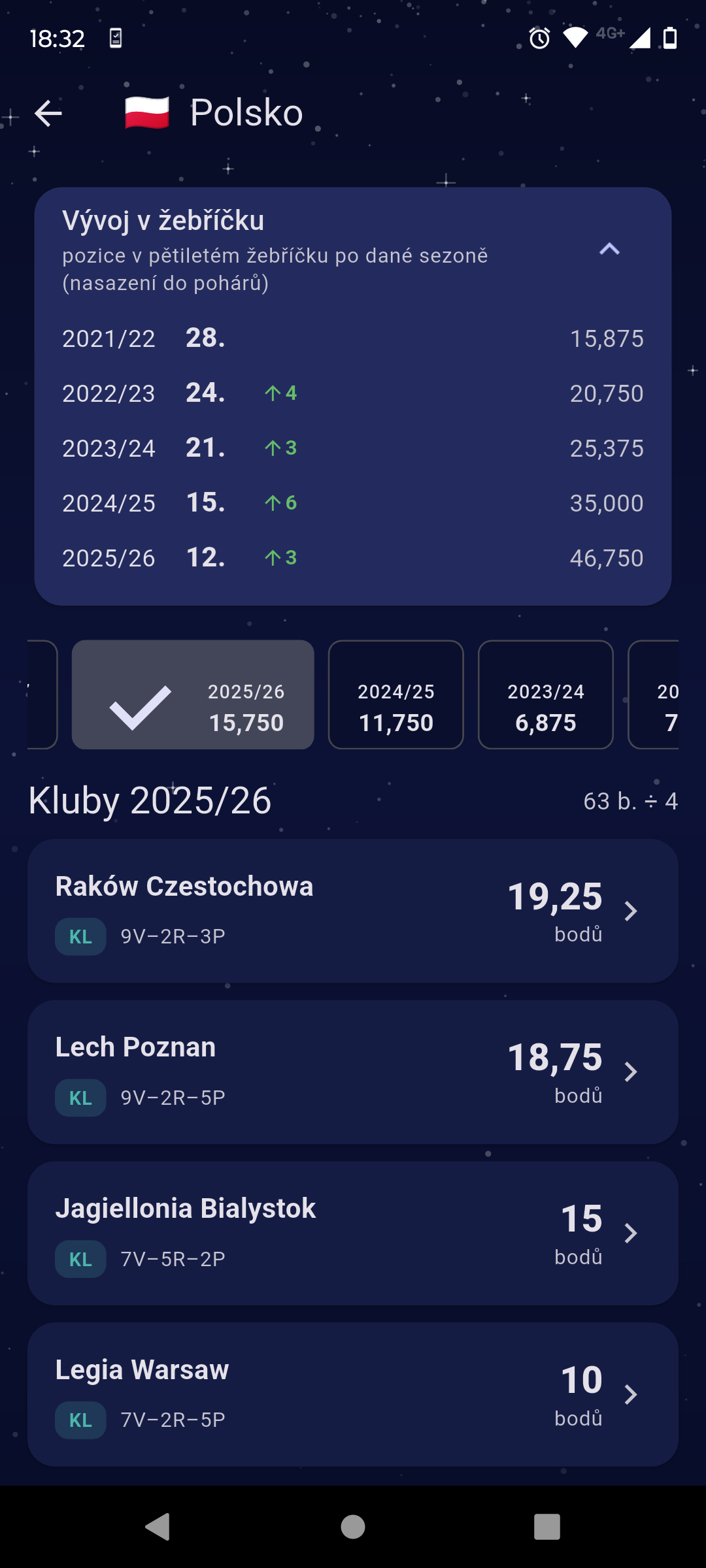
Polish football has made a serious leap forward over the past few years. Just a handful of seasons ago, Poland was sitting around 30th in the UEFA country coefficient ranking. Today it's 11th and knocking on the door of the top 10.
A jump like that is worth paying attention to. It doesn't mean Polish football has suddenly become a European powerhouse. What it does show is that Polish clubs have been earning noticeably more points in European competition in recent seasons than they used to.
So what's behind it? There's probably no single, clean answer. A coefficient captures results — it doesn't explain why a club or a whole league arrived at them. Still, a few factors line up both in timing and in logic with Poland's rise.
The Conference League Opened New Doors
One of the most visible factors is the creation of the Conference League in 2021/22. The new competition obviously wasn't an advantage for Poland alone, but for countries in the performance bracket around 8th–20th, it marked a real shift. Their clubs now have a much more realistic path into the league phase of European competition, and in Conference League qualifying they more often find themselves in the role of favorite.
Also important is the system that lets teams eliminated from a higher competition's qualifying rounds drop down and continue in a lower one. A setback in an early qualifying round doesn't automatically mean the end of a club's European run — it can keep earning points for its country regardless.
That extra volume of opportunity may well be one of the reasons Poland has managed to collect so many points in recent years. The Conference League alone obviously doesn't explain Poland's rise by itself — other countries got the same opportunity, and Poland simply made unusually good use of it. Exactly how the third European competition changed the calculus for mid-tier leagues, though, is a topic for its own article.
It's Not Just About Legia
An even more interesting picture emerges when you look club by club.
Over the last ten seasons, according to data in Coeff, Polish clubs have earned 247.5 points combined. Legia Warszawa leads with 82.5 points, followed by Lech Poznań with 58.25. But two other names have added themselves very visibly in recent years: Jagiellonia Białystok with 39 points, and Raków Częstochowa with 36.75. (The full 15-year, club-by-club breakdown is in a companion piece.)
Those last two numbers might be the most interesting part of the whole story.
Jagiellonia and Raków combined for 75.75 points — almost as much as Legia alone. That doesn't make Legia any less important; over the ten-year window it's still comfortably Poland's most successful club. What's striking is that most of Jagiellonia's and Raków's points came in just the last five seasons — exactly the period when Poland's national coefficient began its sharp climb. It shows that Polish clubs' European points are no longer concentrated in just one or two traditional names, and that in recent years other teams capable of contributing meaningfully have joined Legia and Lech.
Raków is a particularly striking example here. Across the ten-year window, it doesn't even show up in European competition until 2021/22 — yet in the five seasons since, it has collected 36.75 points. And its rise wasn't a one-season fluke: under owner Michał Świerczewski, the club worked its way up from the lower divisions to a league title in 2022/23. Świerczewski became Raków's sole owner at the end of 2014, and the club underwent significant sporting development from there.
Jagiellonia's story is different, but the outcome is similar. In recent years the club has become one of the Polish sides capable of regularly playing in European competition, and in 2024/25 it even reached the Conference League quarterfinals — the best European result in the club's history.
That matters a great deal for a national coefficient. One successful club can bring in a large haul of points, but when other competitive teams join in, a country has a far better shot at sustained growth.
An Effect That's Been Building for a While
Another possible piece of the explanation is the longer-term development of Poland's football environment.
A major milestone was Euro 2012, which Poland co-hosted with Ukraine. The tournament brought new, large stadiums in Warsaw, Gdańsk, Wrocław and Poznań, and infrastructure modernization extended beyond the four host cities as well. Ekstraklasa itself now describes the last two decades as a substantial infrastructural transformation of Polish football.
It would be too simple, though, to claim new stadiums caused the coefficient's rise. We can't measure a direct link. But more modern stadiums can create better conditions for attendance, commercial revenue, and how clubs function overall — and those are the kinds of factors that can show up in sporting performance only years later.
The size of the Polish market deserves similar treatment. Ekstraklasa plays in a country of 38 million people, and football holds a genuinely strong position in Poland. The league's economic strength, attendance, broadcast and commercial revenue, and clubs' ability to attract investors can all create an environment where it's easier to build competitive teams. Ekstraklasa's economic footprint has, in fact, been growing in recent years.
Even here, though, it's hard to say this single factor directly caused the coefficient's rise. It's more likely just another piece of a bigger picture.
Maybe It's Mostly a Combination of Things
This, to me, is the most interesting part of Poland's rise. There may not be one defining moment behind it.
The Conference League offered clubs new opportunities and often turned underdogs into favorites — and Poland made the most of that chance. At the same time, more clubs capable of regularly playing in Europe have emerged in recent years, and some of them, like Raków and Jagiellonia, have grown dramatically. On top of that come the longer-term factors: more modern infrastructure, market size, attendance, clubs' financial footing, and specific individual investments. In some clubs' cases, it's clear that sustained work and a stable project can produce results that would have looked highly improbable just a few years ago.
So maybe the right approach isn't to look for a single reason Poland climbed from the lower half of the ranking to the doorstep of the top 10. It's more likely that several things lined up at the right time.
And the result shows up directly in the coefficient. Within a few years, Poland has moved from a deep position outside the top 20 (28th) to 11th, and is now realistically fighting to break into Europe's top 10 football nations. Czechia, for what it's worth, shows a similar path is possible — it has moved in recent years from roughly the middle of the second ten up into the top 10 itself. The main difference is simply how dramatic each country's climb has been.
The coming seasons will show whether Poland's rise is a lasting shift or just a very well-executed chapter. A coefficient, in the end, doesn't reward potential, market size, or the number of new stadiums. It rewards European results. And Polish clubs have to keep earning them, year after year.
Coeff tracks the ranking and every club's season-by-season points live — free, no sign-up.